

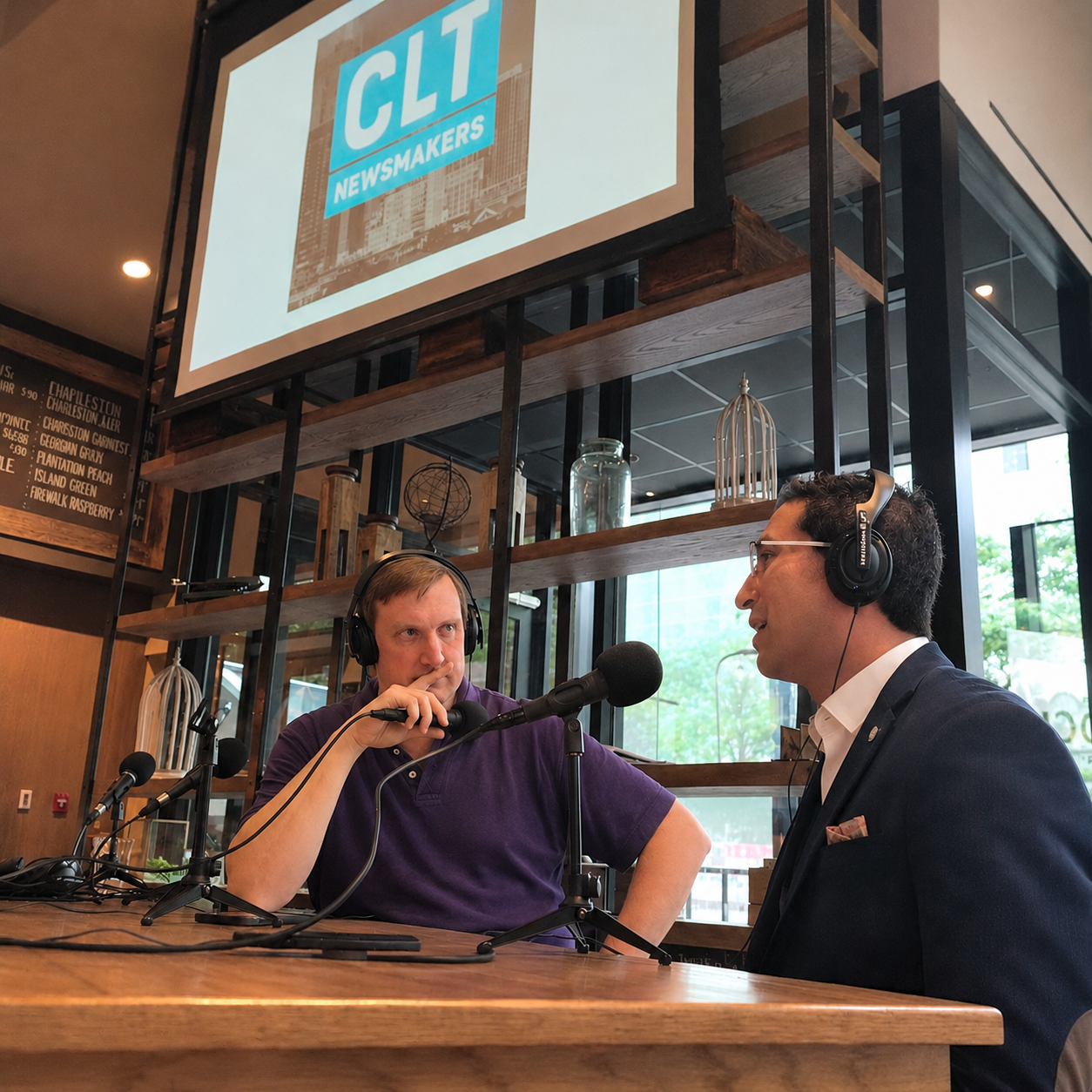
Queen City Podcast Network is the first large-scale hyper-local podcast network in the United States, home to 36+ active shows across 11 categories covering Charlotte news, sports, arts, mental health, business, and community storytelling. Founded in 2018 by Brian Baltosiewich, a 25-year audio veteran, QCPN produces more than 70 episodes a month and reaches a Charlotte-first audience that no national podcast and no local radio station is currently serving. Engaged in May 2026 through a commission-based brand strategy and sponsorship sales partnership, my role sits at the intersection of brand architecture, visual identity, sponsorship infrastructure, and strategic sales counsel. The mandate is to reposition the network from "a collection of podcasts you can advertise on" to a Charlotte-first media platform whose product is the network itself.
Brief:
The mandate from the outset was to build brand equity that compounds over years, not campaigns that spike over quarters.
Problem:
QCPN has spent eight years earning Charlotte's trust and building a roster of 36+ shows, but the brand and the business had never caught up with what the network actually was. It has being sold like a small local radio station. It was being described like a podcast collection. And it was being positioned against competitors it didn’t actually compete with.
Three problems compounded:
No shared language for what the network is. The founder described QCPN as "the network," but the structure still operated as a wheel-and-spoke model, with every host, every sponsor, and every operational decision routing through Brian, the founder. A dynamic “mesh” network, the thing that gave QCPN a defensible moat, had never been named, let alone sold.
A sponsorship model built on the wrong metric. The existing sponsor deck priced the network on CPM share-of-voice at $2K to $7.2K per month, a media-buy model that contradicted the network's actual value proposition with errors that killed credibility in a sponsor meeting (100% annual share of voice priced lower than 50% annual share of voice). Prospective sponsors were being asked to buy audio inventory when what the network actually had to sell was community infrastructure.
A visual identity that undersold the editorial substance. The original brand lived on pure black backgrounds with three shades of green and a geometric sans wordmark. It read as more of a tech-forward, cold, and generic brand. It didn’t carry the warmth, community focus, or 25-year storytelling depth the network was actually built on. It couldn’t stretch to hold the sponsor deck, the event materials, the website rebuild, or the eventual replication into other markets.
Solution:
Rather than refresh the surface, the work was structured as a full brand matrix engagement: Brand Clarity Score, Brand Pulse, Tribe Mapping, Positioning Lab, and Visual Identity, each feeding the next. The sponsorship architecture became a downstream consequence of the strategic work, not a separate deliverable.
The guiding reframe: the network is the product, and the product is relationships. Twenty-five years of trust, 36+ hosts, a Charlotte-first audience, and the operational infrastructure to connect them to each other. The sponsor is not buying ad inventory. The sponsor is plugging into a living network.
This meant:
Naming the mesh. Surfacing the wheel-to-mesh distinction so the network could be sold as structural infrastructure rather than as a catalog of shows. The founder had built the mesh without knowing it was the product. Naming it made it sellable.
Replacing CPM with a sponsorship menu. Pricing shifted from media-buy share-of-voice to a modular plate of options: title sponsorship, category sponsorship, event sponsorship, custom initiative sponsorship, and non-cash considerations. The pitch became partnership language, not inventory language. The math worked.
Segmenting sponsors by relationship type, not dollar amount. Three archetypes: Aligned Local Believer, Category-Native Brand, Institutional Partner. Each archetype got its own sales motion, sales cycle, deck language, and discovery questions. The founder stopped trying to sell the same thing to everyone.
Evolving the visual identity without rebranding. The audio-wave mark stayed. The three greens stayed. Everything else evolved: cream base instead of black, deep forest as the primary dark tone, Fraunces as the editorial serif wordmark, warm accents and expanded neutrals, a layout system built to scale across the sponsor deck, the website rebuild, and the eventual replication of QCPN into other markets.
Building sales infrastructure the founder could actually operate. A sponsor pipeline tracker with 72 working formulas, dropdowns for stage and archetype, color-coded urgency flags, and a conversation log structured around the Going Deep methodology. Not a CRM. A working system for a founder whose brain works in relationships, not systems.
Execution Work Associated With the Solution Brand Built
Strategic Brand Audit
Ran QCPN through the full brand matrix framework (Brand Clarity Score, Brand Pulse, Tribe Mapping, Positioning Lab) to establish the structural problems underneath every surface symptom the founder had been trying to solve. The audit produced a 6.4 out of 10 baseline score and surfaced the wheel-to-mesh distinction, the four-audience tribe structure, and the "network is the product" reframe that became the foundation for every downstream decision.
Brand Core & Positioning
Codified values (Local Stories First, Human-Made, Excellence as Standard, Diversity of Voice, Reliable Partner), brand promise ("Of all the things our clients have to worry about on a project, we're the last thing they worry about"), mission, vision, and the not-statement that rolled out as the network's new pre-roll tag ("Every podcast created by actual humans"). The not-statement became a brand-safety asset for sponsor pitches, not just an internal policy.
Four-Audience Tribe Mapping
Developed a bespoke four-audience structure (Listener, Podcast Client, Sponsor, Influencer) because the standard three-audience model missed the structural difference between QCPN's two purchaser types. Sponsors and podcast clients have different priorities, objections, sales cycles, and language. Treating them as one audience was costing deals. Separating them clarified the entire sales motion.
Sponsor Archetype Synthesis
Built three sponsor archetypes segmented by relationship type rather than dollar amount: Aligned Local Believer (warm, fast-close, local), Category-Native Brand (category-match, medium-length cycle, marketing-director-led), and Institutional Partner (long cultivation, VP-level, narrative-driven). Each archetype got its own sales cycle, discovery questions, objection map, pitch structure, and twelve-month sequencing.
Visual Identity Evolution
Refreshed the identity without rebranding. Kept the audio-wave mark and the three greens. Moved from pure black to warm cream as the base color, from a geometric sans wordmark to a Fraunces serif wordmark, from a three-color palette to a system that includes deep forest green as anchor, mid-green and lime as supporting, terracotta and amber as warm accents, and expanded warm neutrals. Introduced subtle paper texture to counteract flat digital. Built a photography direction ("Use Humans") that puts hosts and listeners at the center of every touchpoint. The system was built to carry the sponsor deck, the website rebuild, the anniversary event, and eventual replication into other markets.
Strategic Partnership Architecture
Advised on the broader activation strategy including the network host survey, the 25th anniversary event as a strategic lever rather than a party, the Lauren Ainsley partnership for mesh-network activation, and the three-track sponsor pursuit strategy (Archetype 1 warm pursuits in parallel with a Title Sponsor track in the Ortho Carolina model, supported by event and lunch-and-learn sponsorships). The engagement continues as embedded counsel through the anniversary event and the brand's full market activation.
Sponsorship Deck & Sales Infrastructure
Replaced the CPM-driven media-buy deck with a story-first partnership deck structured in five acts: why QCPN exists, what the network is, impact and community, how you plug in (the menu), and what happens next. Built the sponsor pipeline tracker, conversation log, and Going Deep post-meeting capture template for the founder. The infrastructure made sponsorship sales a repeatable system rather than a founder-dependent process.